
What we believe
You stopped using one agent a while ago. Two terminals, two subscriptions, two models from two companies. They don't talk. When one runs out of quota, you paste the last twenty lines into the other and start over. When one checks its own work, it says "looks good." And tomorrow it will make the same mistake it made today, because nothing carried over.
Sno Station starts from a simple idea. The agents you already run should work as one squad on your machine, and the place they work should get a little better every night.
Every morning, a little smarter. While you sleep, Sno Station reads what your agents did that day and looks for the mistakes that keep coming back. It writes the fix into the agents' own skills, a short rule or a changed step, and leaves it for you in the morning. Nothing changes until you say yes. The models stay exactly what the vendors shipped. What improves is the workspace around them, and it improves from your own work, not from someone else's benchmark.
A fast mind and a slow one. People think in two ways. There is the glance that tells you a number is off, half a second, no effort. And there is the slow thinking that works out why. Daniel Kahneman called them System 1 and System 2. The nightly review works the same way. A small decision model, Jev, reads every session in under a second and flags the ones that went wrong. A large model then takes only those and works out what happened and what to change. Reading everything the slow way used to cost too much, so we sampled about eight sessions out of sixty and missed the rest. Now nothing is sampled. On a replay of 276 of our own sessions, the fast pass caught 14 of 19 failed ones, where the large model alone caught 6 of 16. For well under a cent a session.
One builds. The other reviews. Ask an agent to check its own work, and it brings the same assumptions back to the result. Give that work to another agent, and you get a different reader. Claude Code and Codex take separate roles: one implements, the other reviews against your requirements. They exchange findings and corrections through shared context. Either can build or review. We call this Dual Brain. Add more roles, and you have an Agent Squad.
They talk to each other. When one agent is about to run out of quota, it writes a handover: what is done, what is half-done, the exact commit to continue from. Then it wakes the other one and holds on until the brief is received. On our own machine that took fourteen minutes and forty-one seconds, twenty-one tasks into a twenty-seven task build, at 2% quota left. Nobody was awake for it. It all runs through plain files on your laptop. No daemon, no server, nothing to keep alive.
One memory, and it forgets on purpose. Both agents read and write the same memory, so neither starts from zero. Good memory also lets go. A preference you cancelled or a deadline that moved should stop steering your agents the day it changes. We measure that, and we publish the numbers with their source. Memory is the floor of this product. It is not the headline, but everything stands on it.
Skills they arrive with. The squad does not start empty. It comes with the skills we have used every day for six months to run our own agents: reviewing each other, handing off work, turning a job into clear orders, reporting where things stand, looking back at what went wrong. They were written for coding first and are meant to bend to how you work. They are also the skills the nightly review rewrites, so the ones you use most are the ones that get better.
Yours, and it stays yours. Memory, messages and skills live on your laptop. The memory is encrypted from first use, with a key that never leaves your machine. Apache-2.0, edge to edge. The nightly review is the one part that sends anything out: with your consent, the sessions it keeps go to our servers to be judged, and you see exactly what left. Turn that off and nothing leaves. If you walk away from us, your agents' memory and skills walk with you.
Where this goes. Today it is two minds on one laptop. What we are building toward is a whole team around that squad. Several people can watch it work and redirect it, one person holds the baton at a time, and the rules for who decides what are written where everyone can read them. Those rules get better the same way the skills do.
We are building it in public, one piece at a time. What is here runs. What is not here yet, we do not claim.
Who we are
This page was written by one agent and built by another. They run on different harnesses, share one memory, and check each other's work; a person read the result and said yes. That is how we make everything here, including the product that lets you do the same. We run our agents the way we want you to run yours: more than one, never alone, and a little sharper every night than they were the night before. We think the next few years belong to people who work with a squad of agents rather than a chat window, and we are building the workstation those people will want, in the open, one piece at a time. What is here is real and runs. What is not here yet is not claimed.
Built for AI agents
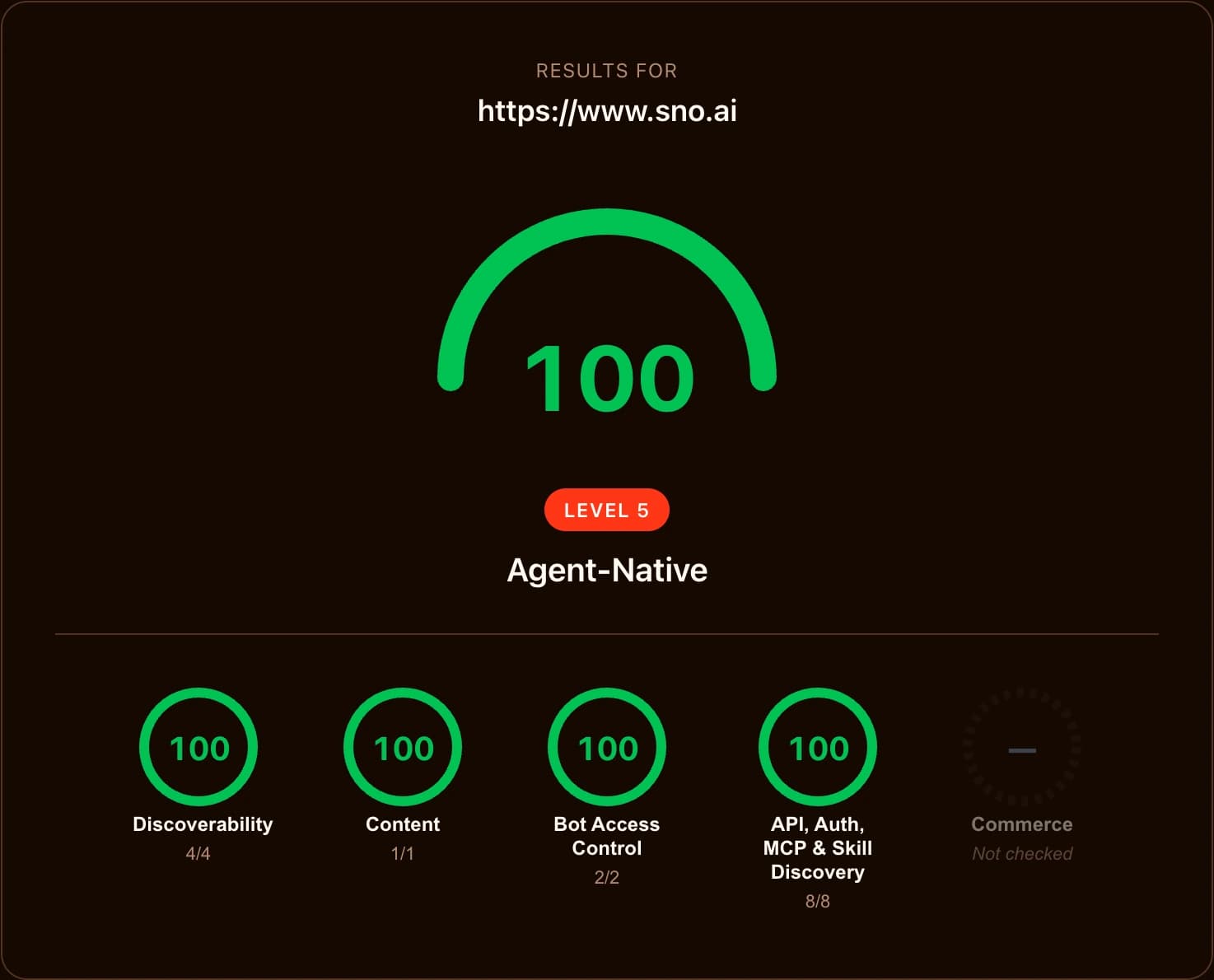
AI agents can read every public page of sno.ai as Markdown, find its API description, and start a person's sign-up on their own. Cloudflare's Agent Readiness Scanner scores sno.ai 100 out of 100, Level 5 (Agent-Native).
How to reach us
Code, issues and discussions: github.com/sno-ai/sno-station.
Security reports: security@sno.ai (never as a public issue).